by D. Patrick Miller
by D. Patrick Miller
_________________________________
My fondest childhood memory of Christmastime is admittedly strange.
I grew up dreading the holiday season, which began for me with my birthday in early November. That was when my chaotic, mentally unstable mom — whose behavior was merely unpredictable the rest of the year — always took a dark turn for the worse. Her disturbance would intensify around my parents’ anniversary in November’s third week, sometimes casting a pall over Thanksgiving, and then build toward some kind of season-ending cataclysm. December would see a lot of manic shopping, alternating with wordless retreats into a closed bedroom. Yet she evinced a dogged dedication to completing the season’s typical rituals and expectations.
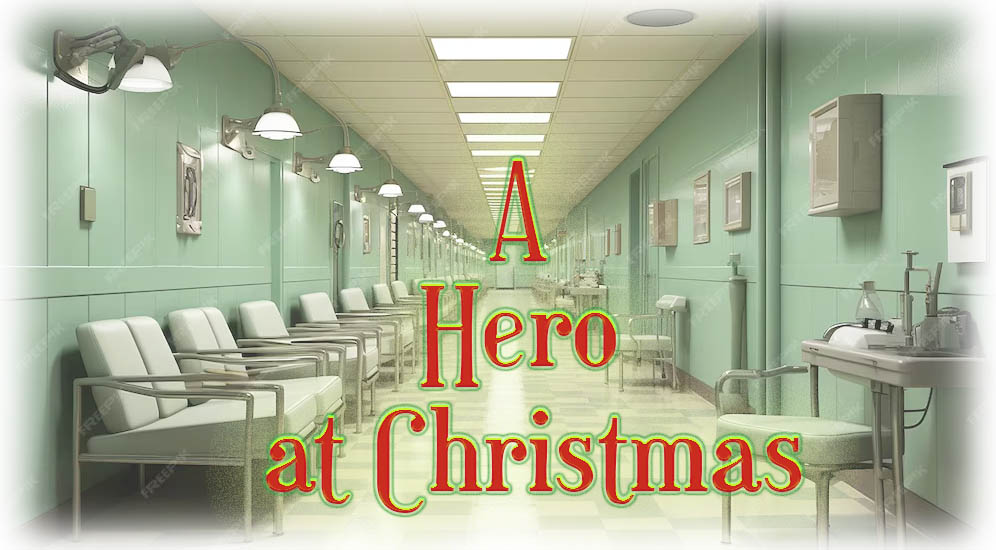
Typically, her commitment to honoring the holidays would fail by December 25th. By then she would either be hidden away in drug-muddled depression, or she'd manage to make a brief appearance at the family’s gift exchange — possessed by a mysterious, angry blackness that was terrible to witness. More than once she spent that day, and/or a few days following, in the psych ward of a local hospital. That was where I would have one of the most memorable Christmas experiences of my youth.
I was about ten during one year when my mother took the family’s Christmas away to the hospital. I went with my dad, and probably one of my sisters, to visit her. But when we got there, it turned out that there was a minimal age limit for visitors to the psych ward. I wasn’t old enough. My dad told me to wait in the downstairs lobby, and for a while I restlessly complied. Then something mischievous arose within me. The straight-A kid and compulsive rule-follower decided to break the psych-ward ban to check in on his mom.
When I look back on this decision, I think it may have been the birth of altruism within myself. The motive surely wasn’t needing to see my mother for some holiday cheer, or for any reassurance about the very crisis she was creating. At these times and in these states, she was the scariest person I knew or could imagine. No, what impelled me to find my way onto the floor of the psych ward was the feeling that it might actually help my mother. I don’t think I’d ever felt that before, as a pure motive.
I was also excited at the prospect of being an outlaw, almost like a spy, sneaking past the hospital’s ban and any actual barriers to reach the psych ward. As it turned out, neither espionage nor any unusual agility was required. I knew the elevators wouldn’t be useful, as they’d likely open to a reception area on every floor. So I roamed around the lobby floor of the hospital until I found a rear stairwell, climbed eight flights, et voila — there I was in cuckoo land.
Almost immediately I understood the hospital ban on young visitors to this floor. The first person I saw as I tentatively paced down the hallway was a teenager, just a few years older than I, disconsolately shuffling toward me in a hospital gown. His eyes had the drugged-out dysphoria I’d often seen in my mother, but I was shocked to see it in someone not much older than myself. I didn’t know you could get crazy so early — and there I was, walking the same hospital corridor as this sad, whacked-out kid.
I didn’t know where my mom was exactly, so I peeked into a few rooms as unobtrusively as possible, which could have gotten me into trouble. But I lucked out and found the room quickly, and there must have been a moment of surprise for all the family present. I don’t remember what anyone said, and my father didn't scold me. My mother looked tearful, ashamed, and shell-shocked, as she usually did after psychiatric drug overdoses landed her in such a helpless circumstance. I don’t remember if she thanked me for flaunting the rules on her behalf, but it didn’t matter. I didn’t need an acknowledgment or an acclamation; I was bursting with personal pride for more reasons than I could grasp.
Whether anyone else thought so, I felt like some kind of hero.
I wouldn’t see my mom in a hospital for another ten years. When I was twenty and living in my first dormitory room in the hometown college, she made good on a lifetime of suicide threats. She took enough of her wide array of anti-depressants to stop her heart twice, but the hospital team revived her twice. She lay in a coma for several days, with an unclear prognosis about her mental capacity if and when she awakened.I was at the hospital when she did. Although she was intubated and could not speak, she managed to indicate that she wanted to write something down in the presence of myself and my dad. Her hands shook crazily as she scrawled large letters onto a note pad, eventually composing the strange message:
I did m ean
to hur t anyo neEarlier in her life, my mom had been an English teacher for young vets returning home after World War II. As I leaned over the side of the hospital bed to decipher her scrawl, I couldn’t help but think how embarrassed she would be to recognize her error. Or had she inadvertently told the truth — that her long-held self-hatred and generalized hostility toward others had finally resulted in a dramatic attempt to hurt anyone?
A couple weeks later, my sisters and I went to see Dr. Wright, my mother’s psychiatrist. Family therapy was not fashionable back in the 1970s, so we had never met him. My mom had a tendency to canonize certain men in her life, beginning with her late father and ending with Dr. Wright, who could apparently do no wrong in her eyes. It was not that my mother ever made discernible progress with her condition, then called manic-depressive and nowadays labeled with the more technical bipolar. It was rather that Dr. Wright seemed to support her long-standing belief that something had always been wrong with her brain, and he provided a never-ending stream of powerful prescription drugs to fix it.
Despite her bad brain, my mother had always let my sisters and I know that we were to blame for a good share of her problems. In fact, we were almost too good for our own sakes, considering that we grew up in the 50s and 60s in the midst of rambunctious social change. We didn’t drink or do drugs, and nobody got pregnant or got anyone pregnant.
No, the problem with us was more ontological. Judy, the oldest, has told me that when she was a young teen, she was accosted by our mother as she came out of the bathroom one morning. Out of the blue Judy was abruptly informed: “You ruined my life! If you hadn’t been born, I could have been an actress.” Mom then disappeared into the bedroom and closed the door, the hallmark sign of slipping into days of wordless depression. My sister Karen recalls being exiled to live in a basement room for no particular reason, and our mother once even took a swing at her — an assault narrowly blocked by our dad, in one of his rare interventions.
Each of us got plenty of irrational threats and hateful messages while we were growing up, regardless of our behavior. By the time of the suicide, we were all pretty certain that we had done something wrong, or could at least do something better to help our mother, in view of her bad-brain problem. Since Dr. Wright probably knew her better than anyone else and she revered him so, he would surely have answers. I remember steeling myself to hear his professional opinion, because I had a distinct misgiving about my role. I really couldn’t see what I’d been doing that was so harmful. But she was my mother after all, and she’d nearly killed herself. There had to be something we could do.After listening to us pour out our concerns and vague guilt, the graying Dr. Wright shook his head and smiled at us with an odd look of helplessness. “I have to tell you kids that I’m surprised," he admitted. "It’s not just that you’ve come to express concern for your mother, which is admirable. I’m surprised that you can manage to express concern for anyone besides yourselves. Frankly I’m amazed that any one of you can even function, given what I know about your mother.”
What transpired next was the first major awakening of my life, a profound shock that would soon alter the direction of my young adulthood. Dr. Wright went on to tell us that not only were we not to blame for any of our mother’s problems, but that the sanest thing we could do was to put as much distance as we could between her and ourselves, permanently. “Your mother nearly killed herself and I couldn’t prevent it,” he confessed. “I’m convinced she will try again, and next time she may take one of you with her.”
He also revealed that he considered his years of treating our mother a failure because he had let her dictate the course of treatment. She had stubbornly resisted talk therapy, group therapy, and hypnosis. Under threat of institutionalization, she had endured several rounds of brutal electroshocks to no good effect. Dr. Wright allowed that he had even considered the use of LSD back when it was still legal and known mostly to the psychiatric community. He eventually decided that the risk of a very bad trip, with no return home, was too high for her. My mother believed in pills, and had made it clear that she would rely solely on pharmaceuticals to treat whatever was wrong with her brain. Just as she'd done with her family, she eventually took control of the psychiatric relationship.
Dr. Wright was certain that her problems were not primarily neurological, but he couldn’t prove it. “Your mother shows all the telltale signs of having been chronically abused as a child, sexually and emotionally, possibly by both parents but certainly by her father,” he told us. “But she’s totally buried all the memories and compensated by reimagining her dad as a saint, which your father has told me was definitely not the case.” At this point I remembered my dad rolling his eyes every time my mother would repeat the story of how her hard-drinking carpenter father, when given the opportunity to bid on the building of a church, insisted on doing the work for free. There were many such Hallmark-style fables of her childhood in my mother’s repertoire.
When Dr. Wright identified the driver of my mom’s insanity as severe and chronic childhood abuse, the problem with our family’s holiday seasons was suddenly illuminated for me: Something terrible happened to her at Christmas when she was little, and it happened again and again, year after year. It was too terrible for her to recognize when it was happening, and thus too obscured to remember. She never had a confidant who was strong & caring enough, or a therapist who was competent enough, to bring it forth in her awareness. So the trauma settled into her as an inarticulate, angry darkness that led her to strike out erratically at her own family, reaching the intensity of a vicious thunderstorm by the holiday season. That's why our family experienced every Christmastime as if it were a siege of dangerous weather.
While I followed Dr. Wright’s advice and left my Carolina birthplace for California, he was wrong on the prediction of her fate. She outlived him and never seriously attempted suicide again, passing away quietly in her sleep at age 72. Before then, I had journeyed roughly through a seven-year health and spiritual crisis that resulted in writing a book about forgiveness that I dedicated to her. It eased our relationship somewhat in her final years. I like to think that it helped her pass peacefully, but there’s no way to know.
In the first year following that book’s publication, I received a letter from a young woman who was starting college. She related that she had recently been suicidal, following a rape in her senior year of high school. A guidance counselor had given her a copy of my book.Then she wrote: “I’m in my first dorm room instead of my grave because of your book.”
As I read that, I gasped and tears stung my eyes. I could not catch my breath for a few moments, stunned, blinking at that handwritten line. To my surprise, I found myself silently thanking my mom for inadvertently helping me to have such an effect on someone’s life. And I felt a peculiar echo of a Christmas visit to the psych ward long before.
For the second time in my life, I felt like a hero.
You can support the writing of feature stories like this one...
D. PATRICK MILLER is the author of a dozen books published by Hay House, Penguin Random House, Hampton Roads Publishing, and his own imprint of Fearless Books. First trained as an investigative journalist, he began writing about spirituality, human potential, and creativity after a seven-year illness initiated his spiritual path. Since that time he has intensively studied A Course in Miracles, the Enneagram system of personality, Jungian depth psychology, shamanism, and other realms of contemporary spirituality. He has also applied spiritual principles and disciplines intensively in his own life, and written about the results. As a magazine and online journalist, Patrick has written over 200 articles for Yoga Journal, THE SUN, Elephant Journal online, and many other media including this website. He is also the founder of Fearless Books and Literary Services, a business which has facilitated the work of many other writers for two decades. [Portions of this essay originally appeared in The Perfect Mother: an in-depth study of forgiveness, a free e-book available from Smashwords.]
 HOME • BOOKS • FEATURES • CONSULTATIONS • STAY IN TOUCH